
Street Karting in Tokyo with Coworkers: 5 Common Pitfalls for Groups of Mixed Ages and Fitness Levels, and How to Avoid Them
Street Karting in Tokyo with Coworkers: 5 Common Pitfalls for Groups of Mixed Ages and Fitness Levels, and How to Avoid Them
"We're all in Tokyo anyway, so let's do one thing together." Someone at an informal get-together says this, and by the time the idea takes shape, you've somehow become the kanji. It happens all the time. A kanji is the person in a Japanese group who takes care of all the arrangements, and it's usually a thankless job. If things go well, nobody notices. Look around the group and you'll see junior colleagues in their twenties next to senior colleagues who laugh and say, "I can't remember the last time I drove."
Some people are comfortable in English and some get a bit nervous about it. When you plan street karting with a group like this, the trouble usually starts during the planning stage. That also means that if you deal with the weak spots early, a group of mixed ages and fitness levels can share the same day without anyone pushing too hard. This article covers five mistakes coworker groups often make when they go street karting in Tokyo, and how to avoid each one.
Five Common Pitfalls and How to Avoid Them
Assuming "Everyone Can Drive"
This is the one you see most. The organizer confirms the headcount on the assumption that "everyone has a license," and then at check-in it turns out one person can't drive. If everyone can laugh it off, fine, but for that person the day is no joke. Street karts are driven on public roads, so a driver's license is required. Which licenses are accepted, how International Driving Permits are handled, what to bring on the day: the organizer shouldn't guess at these for everyone.
The fix is simple. Send everyone who might join a direct link to the official page on driver's licenses and have each person check for themselves. Each person knows their own license best. Adding a short "please check the details on the official site" also makes clear where the organizer's responsibility ends. The same applies to age and other requirements: the most reliable source is the latest information on the official site. You turn each "probably fine" into "confirmed," one person at a time. It's unglamorous, but it's most of the organizer's job.
Not Planning What Non-Drivers Will Do
Once people check the requirements, someone may say, "I won't drive this time." That's completely normal. Some people's licenses won't qualify, some don't feel up to it physically that day, and some would simply rather watch. Each kart has one driver, so nobody can ride along beside or behind someone else. The usual mistake is to have the non-drivers "just wait around at the shop." For the people waiting, that's harder than it sounds.
The fix is to decide in advance where non-drivers will go. There are good places near each shop to spend the time during the tour. From the Shibuya shop and Shibuya ANNEX (the two are at almost the same location), Shibuya Hikarie and Shibuya Scramble Square, home of the SHIBUYA SKY observation deck, are about a 10-minute walk away. Blue Bottle Coffee Shibuya, also about 10 minutes on foot, is another good place to wait with a coffee. From the Shinagawa shop, Shinagawa Shrine is a 5-minute walk. If people are up for a longer walk, Tennozu Isle is 20 minutes away, with canal-side cafés.
From Akihabara Shop 1, the Akihabara Electric Town is right outside the door, and Kanda Myojin Shrine is about a 10-minute walk. From the Tokyo Bay shop, there's the café-restaurant CASICA near Shin-Kiba Station. Keep in mind that these places are only near the shops; they aren't on the tour routes. If you also set a meeting place and time, non-drivers can enjoy the day without feeling left behind.
If fitness levels in your group vary, the organizer should make it clear early that "you can decide on the day whether to drive, depending on how you feel." Informal work gatherings tend to set off a chain of politeness. Juniors defer to seniors, seniors try not to burden the younger members, and nobody feels able to say "I'll sit this one out" before the day comes. If your invitation offers both a "driving group" and a "nearby activities group" from the start, nobody feels awkward about either choice. If the number of drivers might change, check early how changes to the booking are handled.
Trying to Book Everyone on a Weekend in One Go
Coworker get-togethers naturally gravitate toward weekends. But weekends are when street kart slots fill up fastest. If you wait until the headcount is final before acting, the time slot you wanted may already be gone.
The fix is to have several candidate dates from the start, and to move early. If you decide during scheduling that "if our first choice is full, we'll go with this date," you won't have to poll everyone again when you book. If some people haven't committed yet, check the cancellation policy in advance. Cancellations up to 7 days before are listed as free, but please confirm the exact terms on the official site before booking.
If the organizer pays up front and collects later, sharing the amount in advance avoids disputes. Prices vary by season and time of day, so check the latest rates on the official site (Street Kart official site). Bookings are accepted via Facebook, LINE, and email.
How you communicate matters more than you might think. As the group grows, scheduling, license checks, payment collection, and day-of meetup details tend to get scattered across different chats, and it becomes hard to see who has confirmed what. Pick one chat, and have people reply "OK" once they've checked. That alone cuts down on missed steps considerably.
Assuming You Can Make Stops Along the Way
"Let's stop near the Rainbow Bridge and take photos." "Let's get out of the karts in Omotesando and have lunch." Ideas like these come up happily when everyone is planning together. But Street Kart is a guided tour led by a guide, and each shop runs set routes. If you plan around changing the route to suit yourselves, or hopping out of the kart wherever you like to explore, the whole plan falls apart.
The fix is to plan the tour and everything else separately. Put meals, shopping, and shrine visits before or after the tour. For anyone who wants photos or videos, one caution: using your phone while driving is not allowed. For a social media shot, a group photo in front of the shop before departure, or a moment when everyone is smiling after the ride, works perfectly well.
For the shot itself, try a vertical frame with everyone's faces and the karts, or switch to wide-angle and shoot from a slightly low angle. There's one more trap specific to coworker groups: getting caught up in "who's fastest." Street Kart is a tour where you follow a guide and take in the city. If a senior colleague seems a little too fired up, the organizer can gently rein them in. That alone helps the less experienced drivers relax.
Each shop lends itself to certain before-and-after plans. From the Shibuya shop or Shibuya ANNEX, after the ride you can grab a crêpe on Takeshita Street, about a 15-minute walk away. If you still have energy, continue to Meiji Jingu, about 20 minutes on foot. From Akihabara Shop 1, you could visit the museums in Ueno Park, 5 minutes away by train, before the tour, or end the day with soba at the long-established Kanda Yabu Soba, about a 15-minute walk after the tour. It's a classy way to wrap up. From the Shinagawa shop, atre Shinagawa and Shinagawa Intercity near Shinagawa Station have plenty of restaurants. If walking distances could be an issue, choosing a shop close to the station, with less fit members in mind, makes things easier for everyone.
Underestimating Day-Of Travel and Language
The last pitfall is the day-of logistics. Start with getting there. The shops have no parking, so plan to meet using public transportation. The Shibuya shop is a 5-minute walk from Shinsen Station on the Keio Inokashira Line and a 10-minute walk from Shibuya Station. The Shinagawa shop is a 3-minute walk from Kita-Shinagawa Station on the Keikyu Main Line. The Tokyo Bay shop is an 8-minute walk from Shin-Kiba Station. Akihabara Shop 1 is a 3-minute walk from Suehirocho Station on the Tokyo Metro Ginza Line. If people are staying at different hotels, meet up at a station first and head over together. That alone makes latecomers much less likely.
Be careful with time estimates too. Tokyo's major stations have many exits, and transfers involve more walking than you'd expect. Shibuya Station has changed dramatically through large-scale redevelopment, so it's safer not to rely on the memories of anyone who visited years ago. If some members have limited stamina, the organizer should look up routes with fewer transfers ahead of time and share them. That way the group won't already be worn out by the time they reach the shop. Leave plenty of buffer when setting the meeting time.
Then there's language. On the day, the tour is basically conducted in English. Guidance in Japanese or other languages depends on the staff that day and isn't guaranteed. If some members aren't comfortable in English, it helps to assign someone who is to stay close and relay the key points. The website is available in 22 languages, so members whose language is supported can read the safety notes in their own language beforehand. If anything still worries you, contact the official site before booking. Don't leave day-of preparation, including what to wear, to "everyone figures it out." That alone cuts down a lot on small delays on the day.
What Makes Street Kart Great: Why Mixed Groups Enjoy It
After all this talk about mistakes, let's look at what Street Kart does well. First, a trained guide drives at the front. You don't need to memorize the route or decide where to turn. The senior colleague who hasn't driven in years and the junior colleague who doesn't know Tokyo's streets can both just follow the guide ahead. The more varied your group's experience, the more you'll appreciate that.
The routes also pass famous Tokyo sights. The Shibuya shop and Shibuya ANNEX routes include the Shibuya Scramble Crossing, the zelkova-lined avenue of Omotesando, and Harajuku's Takeshita Street. From the Akihabara shops, you go from the Akihabara Electric Town to the red-brick Marunouchi building of Tokyo Station and the streets of Ginza. The Tokyo Bay shop features the 798-meter Rainbow Bridge and the 333-meter Tokyo Tower, while the Shinagawa shop highlights the high-rises around Shinagawa Station and the Rainbow Bridge. Even if members have different sightseeing tastes, after the ride everyone can talk about the same views: "That intersection was amazing, wasn't it?"
Once you're actually driving, you'll be surprised how close you feel to the city. Your eyes are just above the road surface. The angle at which you look up at the buildings, the street sounds rushing past, the wind on your cheeks: it's nothing like getting around normally. A Tokyo you thought you knew starts to feel a little unfamiliar.
You can also choose between shops. Street Kart has 9 shops nationwide, 7 of them in Tokyo. However, Akihabara Shops 1 and 2 are at almost the same location, as are the Shibuya shop and Shibuya ANNEX, so in terms of areas you're choosing between Shibuya, Akihabara, Shinagawa, and Tokyo Bay in Shin-Kiba. If you choose based on where people are staying or where you want to go after the tour, you can keep travel to a minimum.
As for its track record, as of November 2023 Street Kart had run more than 150,000 tours, served more than 1.34 million customers, and received more than 20,000 reviews with an average rating of 4.9 out of 5.0. These figures are all as of November 2023, so please check the official site for the latest numbers.
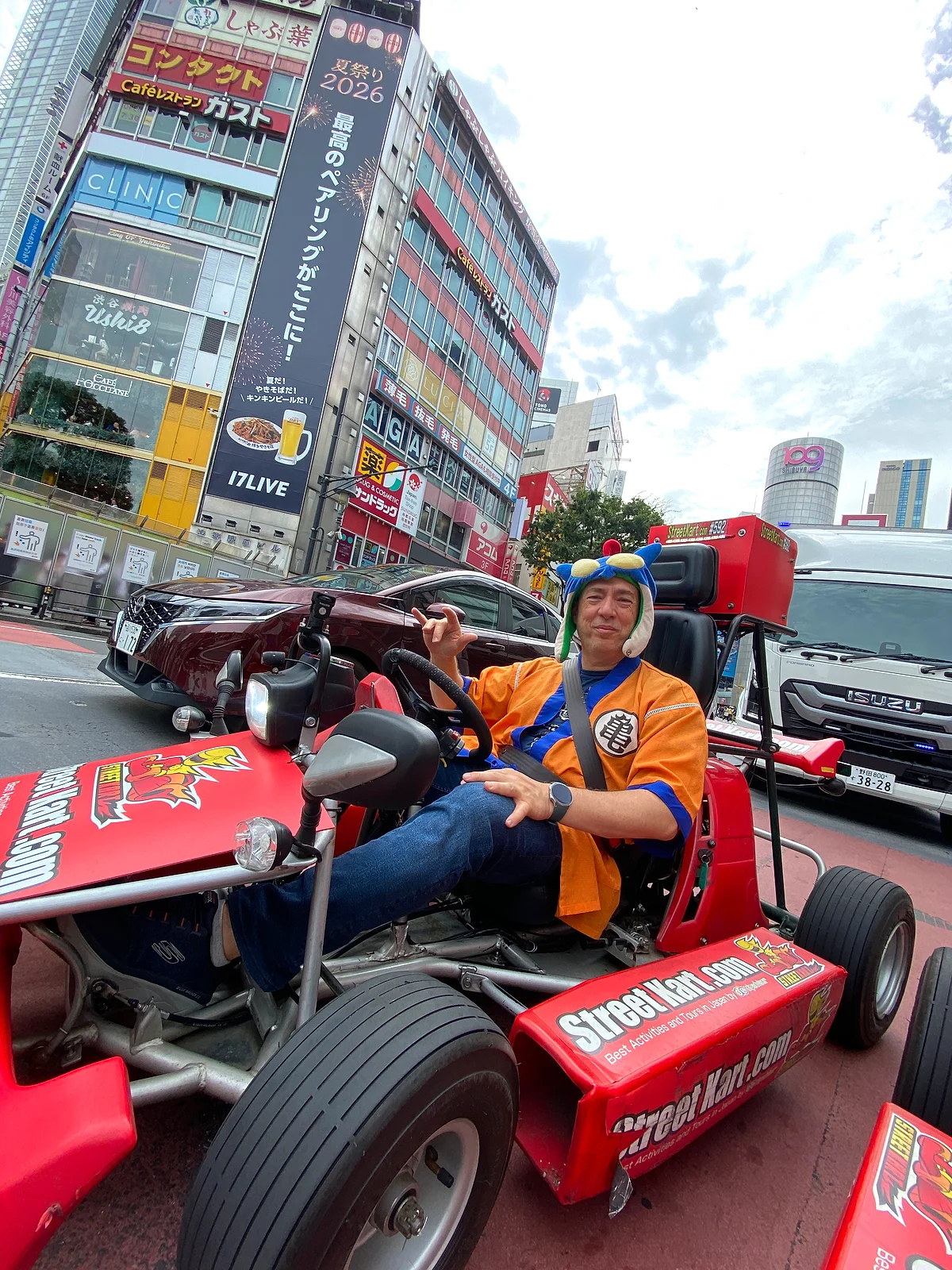
Finally, costumes. You choose from original costumes provided by Street Kart. They're first-come, first-served, so you may not be able to get matching ones for everyone, but even a few people in the same color can change the feel of the group photo quite a bit.
Start Your Organizer Prep Today
Here's a summary of everything above as an organizer's to-do list. Send everyone the license and requirements pages, and sort out early who will drive and who won't. Decide where non-drivers will go and where to meet up. For weekends, have several candidate dates and contact the booking channels early. Since the tour follows a set route, schedule meals and sightseeing before or after. And on the day, meet up by public transportation and assign someone to help with the English guidance.
All of these are steps you take at the planning stage. Precisely because your group varies in age, fitness, and strengths, you close those gaps during preparation. Then on the day, all anyone has to do is enjoy the same views and laugh together. Start by checking the requirements and shop locations on the Street Kart official site, and then begin talking about candidate dates.
Nobody will remember how hard the organizer worked. And that's probably how it should be.
This article was originally written in Japanese and translated using AI. Some expressions may read unnaturally, and we appreciate your understanding. For the most accurate and up-to-date information, please refer to the official site at kart.st.
Street Kart is not affiliated with Nintendo or the Mario Kart series in any way. We do not provide costumes of Nintendo characters, and such costumes may not be worn during tours even if brought by participants.