
Can You Bring Kids to Street Karting in Tokyo? Common Pitfalls to Check Before You Book and How to Avoid Them
Can You Bring Kids to Street Karting in Tokyo? Common Pitfalls to Check Before You Book and How to Avoid Them
"Mom and Dad will drive the karts, and the kids can ride with us, right?"
This kind of conversation often comes up while you're planning a trip to Tokyo. If you book straight away on that assumption, your plans can fall apart at the reception desk on the day. One likely cause is moving ahead without checking. The good news is that this means the problem can be avoided before you leave.
This article is for groups of mixed ages and energy levels who are thinking about street karting in Tokyo. We'll go through the places where people tend to stumble and how to avoid each one. We won't state the participation requirements here, because the official website is the place for that. This article focuses on where to check, what to check, and when.
There's Just One Thing to Understand Before You Book
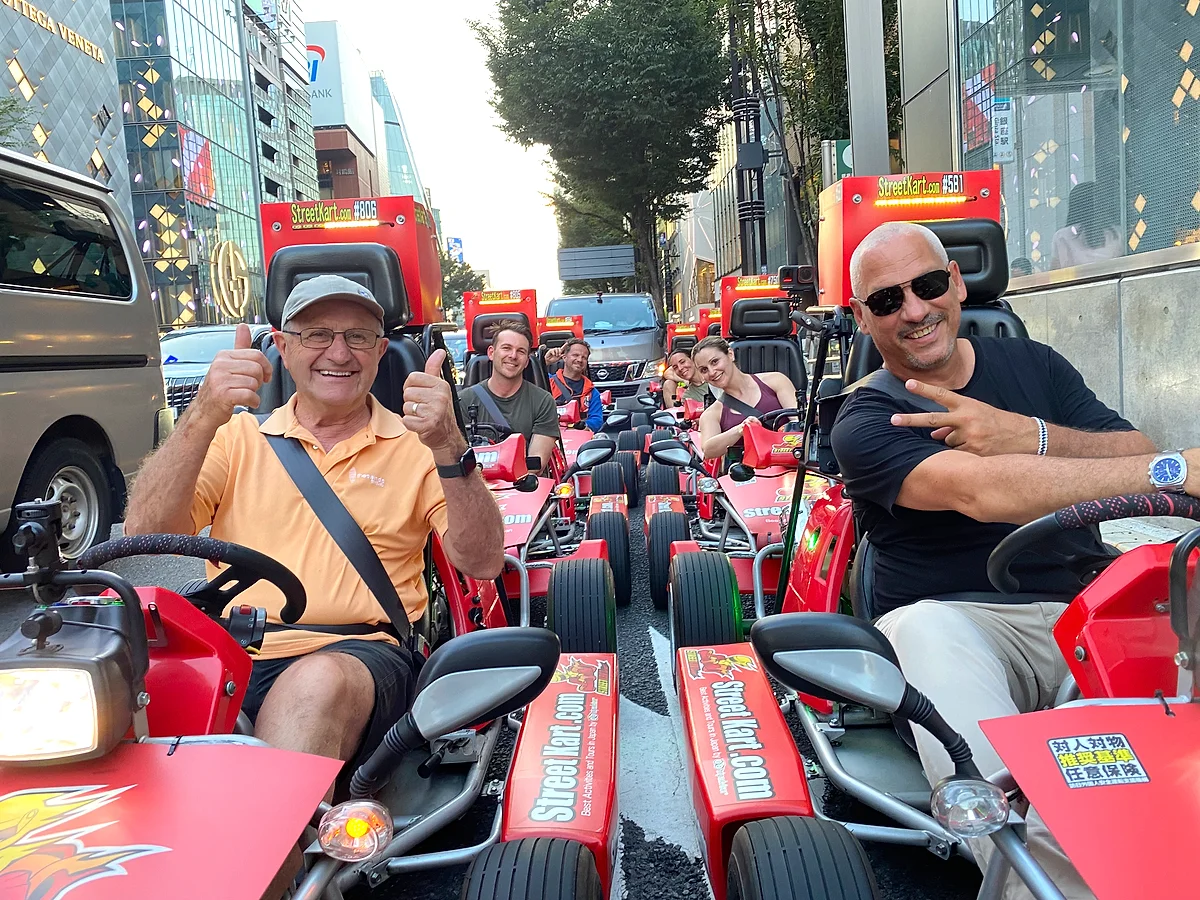
First, one key point. Street karting is a tour where each driver rides alone in their own kart. It isn't like a sightseeing bus, where everyone rides in one vehicle together.
If you come from a place where it's normal for the whole family to ride on the back of a scooter, it's natural to think, "Maybe a small child could ride with me." That's the first pitfall. Passengers are not allowed in the karts. Only people who are able to drive can take part, each behind their own wheel.
So if your group has both drivers and non-drivers, you'll need a plan for spending the time separately. Deciding this before you book makes a big difference to how the day goes.
Before booking, each driver should check the requirements (age, driver's license, what to bring, and so on) on the official website. This article won't state them for you. Please follow the latest information there.
Pitfall 1: Planning by Headcount Alone, Assuming "Everyone Can Ride"
One possible mistake is planning by numbers alone: "Four adults and two kids, so six karts."
Whether someone can drive depends on their driver's license as well as their age. The type of license, whether a license issued abroad is accepted, what you need to bring on the day: each of these has detailed rules. So even among adults, one person might be able to drive while another can't. If you got your license outside Japan, be especially careful. The license you have may not be accepted as it is.
What to do is simple. Everyone who plans to drive should read the official page on driver's licenses themselves. If I were you, I wouldn't let one person check for the whole group and decide it's "probably fine."
Post the link to that page in your trip's group chat and ask each person to reply with whether their own license works. That alone makes it much less likely that everyone assumes someone else checked. Some license-related paperwork can take time, so it's safest to start as soon as your travel dates are set.
Pitfall 2: Thinking "They Can Sit Next to Me" or "On My Lap"
As mentioned above, the karts are single-seaters. A child can't sit on your lap or next to you. Don't expect that asking for "just a little while" or promising to "drive slowly" will change anything.
This is the point to be most careful about. If a child arrives at the shop excited to ride and only then finds out they can't, the mood is hard to recover. The adults won't enjoy the drive they were looking forward to either.
I think it's best to tell your kids ahead of time: "Today Dad (or Mom) is driving a kart. While they do that, we're going to do something else that's fun."
If you plan one special activity for the non-drivers too, their time becomes a second plan for the day instead of just waiting. Zoos, aquariums, parks: Tokyo has plenty of places where kids get to be the stars. You'll find specific suggestions for each location in the next section.
Pitfall 3: Not Deciding What Non-Drivers Will Do
Splitting up isn't a problem in itself. The problem is arriving on the day without deciding where the non-drivers will go and what they'll do during that time.
Tours are led by a guide. Don't build your plans around leaving the tour midway to meet up, or making a detour to pick someone up. You also can't text or call each other while driving, so don't count on sorting things out by phone along the way. While you're behind the wheel, your only job is driving.
This article also can't say whether there's somewhere to wait at the shop, or whether non-drivers can come along to reception. If either matters to you, the surest option is to ask when you book.
Tour length varies by plan and location, so check the official website first. Then fill the time between when the driving team leaves and when it returns with plans for the non-driving team. Decide where and when you'll meet up before you set off.
There are seven locations in Tokyo, but they aren't in seven separate areas. Akihabara 1 and Akihabara 2 are close to each other, and so are Shibuya and Shibuya Annex. Check which location you booked, then plan how to spend your time nearby.
The Shibuya tours run around Takeshita Street and Omotesando. For the non-driving team, I'd suggest Yoyogi Park or Meiji Jingu Shrine, both about a 20-minute walk from the shop. Walking among the trees, you'll almost forget you're in the middle of the city.
Do skip the plan of waiting along the route to wave the karts by, though. Standing still with small children in busy areas isn't safe, and the karts are gone in an instant. You'll probably get a longer conversation out of looking at photos and videos together after you meet up.
From Akihabara, Ueno Park is about five minutes away by train. Ueno Zoo is inside the park, which makes it easy to plan a zoo visit while the driving team is out. If you have older family members who find walking hard, plan to take it slow and rest on benches along the way.
Some routes pass the red-brick Tokyo Station building and the streets of Ginza. When you meet up, ask, "Where did you drive?" You'll probably see a slightly proud face.
Shinagawa Shrine, about a five-minute walk from the Shinagawa location, is easy to visit even if you only have a short time. It has stone steps, so anyone with weak legs or back problems shouldn't push themselves. If you can walk a bit farther, Tennozu Isle is about 20 minutes on foot. Waiting at a canal-side café while you watch the water is a nice way to pass the time too.
The Tokyo Bay location's tours run around Rainbow Bridge and Odaiba. For the non-driving team, an easy plan is to go to Kasai Rinkai Park, about 15 minutes from the shop by car, and spend time at the Tokyo Sea Life Park aquarium. It's a big park with a giant Ferris wheel, so kids are unlikely to get bored.
Pitfall 4: Waiting Until Everyone Is Confirmed to Book a Weekend Slot
"Let's book once everyone's schedule is confirmed." While you're still saying that, the weekend slots fill up. This happens a lot. Saturdays and Sundays book up quickly, so I recommend acting early.
Group trip plans change easily because of a child getting sick or travel delays. That's why it helps to know the cancellation terms before you book. Cancellation is listed as free up to seven days in advance, but terms can change, so check the latest details on the official website.
You don't need to wait for everyone's schedule to line up. Once the license checks are done and you know who will drive, start thinking about booking. Bookings are accepted through Facebook, LINE, and email. Contact details are on the official website.
Prices vary by season and time of day, so check the official website for the latest information. When you set your budget, use the information available when you book, not old figures you saw in articles or on social media.
Pitfall 5: Assuming Language Will "Work Out on the Day"
Instructions on tour day are basically given in English. Whether you can get guidance in Japanese or another language depends on the staff that day, and it isn't guaranteed.
If you go in thinking "it'll work out somehow," you could struggle at the most important moment, such as the safety briefing. Each driver needs to hear the briefing and understand it themselves. And since the karts are single-seaters, nobody can sit next to you and translate.
The official website is available in 22 languages. That's separate from the instructions given on the day, but check the official website for the supported languages and what the briefing covers. Reading it once before you hear the explanation in English is something I would always do.
If you aren't confident in your English, it's a good idea to send a question through the official website before you book. If the person in your group who is best at English will be on the non-driving team, you could ask them to handle the advance checks.
Pitfall 6: Not Realizing It's an Open-Air Vehicle
The karts have no roof or windows, and you sit very close to the ground. The wind hits you right in the face, and the engine's vibration travels through the steering wheel into your palms. Look to the side at a red light and the tires of the bus next to you are right at eye level. That exposed feeling is exactly what makes it fun, but it also means you feel the full effect of the weather and how tired you are.
If anyone planning to drive is older or finds it hard to sit for long periods, ask yourselves once whether everyone really needs to drive. A trip can be great without everyone doing the same thing. The drivers enjoy their drive, and the others enjoy their own time. That way, nobody has to push themselves.
The official website has guidance on what happens when it rains and on what to wear. I'd suggest checking it once when you book and again the day before. Tokyo can get very hot or very cold depending on the season, so don't wait until you get there to think about it.
The shops don't have parking. Please use public transport. If the non-driving team also plans to get around by train, it's easier to decide where and when to meet up.
A Final Check Before You Hit "Book"
Here's everything above, arranged in the order to discuss it as a group before booking.
First, each person who wants to drive checks the participation requirements and license rules on the official website. Next, split into drivers and non-drivers. Tell the kids in advance that they won't ride a kart but will have a different treat instead. Then check which location you're booking and how long the tour takes, and decide where the non-driving team will go and where you'll meet up. Finally, if it's a weekend, book early, and check the cancellation terms, the weather guidance, and the language used on the day.
If you follow this order, nobody should end up at reception saying, "Wait, I can't ride?"
So Your Trip Memories Aren't Built on Someone Missing Out
Street karting isn't something everyone in the group gets to drive. But that doesn't mean you can't enjoy it together. While the driving team cruises the streets of Tokyo, the others spend time at a zoo or park. In the evening you meet up and show each other your photos. One person talks about the wind, another about the giraffes. All of that together makes one trip.
Start with the people who want to drive opening the official driver's license page. Once the requirements are confirmed, the next step is choosing your date and location. If it's a weekend, book early and make it a day everyone can enjoy without overdoing it.
This article was originally written in Japanese and translated using AI. Some expressions may read unnaturally, and we appreciate your understanding. For the most accurate and up-to-date information, please refer to the official site at kart.st.
Street Kart is not affiliated with Nintendo or the Mario Kart series in any way. We do not provide costumes of Nintendo characters, and such costumes may not be worn during tours even if brought by participants.