

Experience Shibuya, Ginza, and Akihabara from 40cm Above the Ground — How Street Kart Transforms Your Travel Memories
At Every Red Light, Strangers Flash You a Smile and Wave
Have you ever been on the looked-up-at side of the Shibuya Scramble Crossing, rather than looking up at it yourself? When you race down Tokyo’s main streets from just a few dozen centimeters off the ground — low enough to feel the heat radiating off the asphalt — the city’s most familiar landmarks reveal an entirely different face. Street Kart is the pioneer of public road go-karting, having conducted over 150,000 tours for more than 1.34 million participants. With an average rating of 4.9 stars across more than 20,000 reviews, the numbers speak to an experience that goes far deeper than simply “seeing the sights.”
From Akihabara to Ginza — A Two-Hour Route Through Three Different Tokyos
The Electronic Buzz of Akiba Fades as the Silence of the Imperial Palace Draws Near
Driving a kart down Akihabara’s Chuo-dori, you can’t help but gasp at the sheer presence of neon signs looming overhead. Background music spills out from anime shop storefronts on both sides, blending with the rumble of your kart’s engine. Yet within minutes the scenery transforms completely — once you clear the Kanda office district, the vast greenery of the Imperial Palace outer gardens opens before you. The sky, which had been hemmed in by skyscrapers, suddenly expands, and you can feel the shift in the breeze on your skin. This area is well known as a quintessential Tokyo sightseeing zone, but viewed through the kart’s low vantage point, even the sense of distance and depth feels entirely different.
From Tokyo Station’s Red Brick to Ginza 4-Chome’s Ribbon of Light
Heading south with the Imperial Palace to one side, the red-brick facade of Tokyo Station’s Marunouchi building appears straight ahead. There are few luxuries quite like gazing directly up at this Important Cultural Property, completed in 1914, with nothing but open sky above you. Continue onward and you arrive at the Ginza 4-Chome intersection, marked by the iconic Wako clock tower. Along the boulevard of high-end boutiques, the glow from shop windows reflects off the asphalt, transforming the road itself into a ribbon of light. There are expressions of Tokyo visible only from this street-level perspective — details you would never notice simply walking along the sidewalk.
Shibuya, Harajuku, and Omotesando — Racing Through the Heart of Youth Culture with the Wind
When the traffic signal changes at the Shibuya Scramble Crossing, roughly 3,000 people step off the curb at once. There is something wonderfully surreal about looking up at that spectacle from a kart seat. Pedestrians who spot you reach for their phones and wave. Before you realize it, you’ve become part of Tokyo’s streetscape. The low vibration of the engine climbing Dogenzaka, the sweet scent of crêpes drifting past the entrance to Takeshita-dori, the dappled sunlight filtering through the zelkova trees lining Omotesando — your senses are fully engaged throughout the roughly one-hour course, delivering a density of experience that no tour bus window could ever match. You visit Tokyo’s most popular spots while absorbing the city’s sounds, scents, and temperatures with your entire body. That is what makes street karting a uniquely Tokyo experience.
Why Travelers Choose Street Kart
One major reason visitors choose this experience is the dedicated guides, specially trained for international drivers. Even if you are unfamiliar with Tokyo’s complex road conditions, you can safely navigate the sightseeing route simply by following your experienced guide’s kart. Street Kart was an industry pioneer in establishing this guided system, and the track record they have built translates directly into peace of mind.
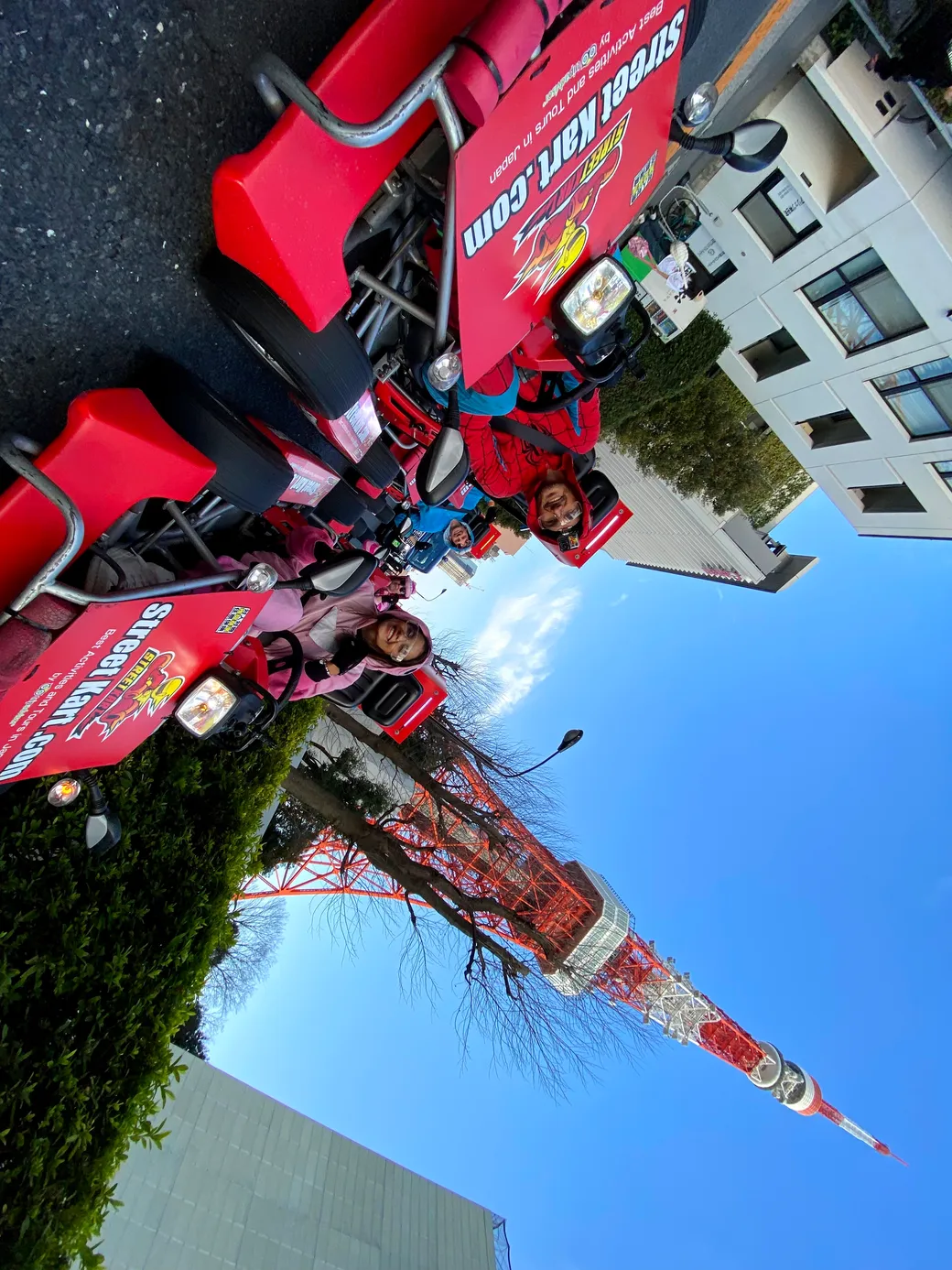
With six locations in Tokyo alone, travelers can choose a departure point that suits their accommodation. Options range widely — a route from Akihabara to Ginza, a course through Shibuya to Harajuku and Omotesando, or a ride from the Tokyo Bay location that takes in both Rainbow Bridge and Tokyo Tower in a single outing. Locations in Osaka and Okinawa make it easy to work a kart experience into a multi-city Japan itinerary as well. A fleet of more than 250 karts means they can accommodate groups of all kinds, whether friends, couples, or families.
The website supports 22 languages, so language is rarely a barrier when booking. Tours are conducted in English, making it easy for travelers who are not confident in Japanese to join in. The fee includes a photo service by the guide, so you can stay focused on driving while still coming away with social media-worthy shots. You are welcome to wear costumes while driving, though Mario Kart-related costumes are not provided. Street Kart is an independent public road karting experience with no affiliation whatsoever to Nintendo or the Mario Kart series. Certain requirements apply for driving licenses, including international driving permits, so it is a good idea to check the details in advance on the license information page. Course details for each location can also be found on the tour information site.
Beyond the Guidebook — Discover Another Side of Tokyo
Tokyo Tower, Shibuya, Ginza, Akihabara. There is a kind of trip where you can say you didn’t just “see” the famous sights listed in every guidebook — you “raced through” them. The memory of driving with the wind in your face, breathing in Tokyo’s air with its mix of exhaust and street-food aromas, will stay with you as something truly special — an experience that no train or bus ride could ever replicate.
Reservations tend to fill up quickly on weekends and holidays, so once your dates are set, check availability early at kart.st. Weekday afternoons tend to be less crowded and offer favorable lighting for photos. On your next trip to Tokyo, consider adding an adventure from 40cm above the ground. The familiar scenery will look like an entirely different city.
